The story
behind the design.
An imaginative tale from Sages Of The Past.
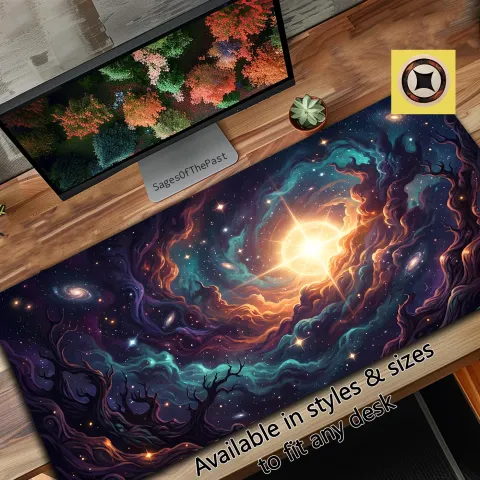
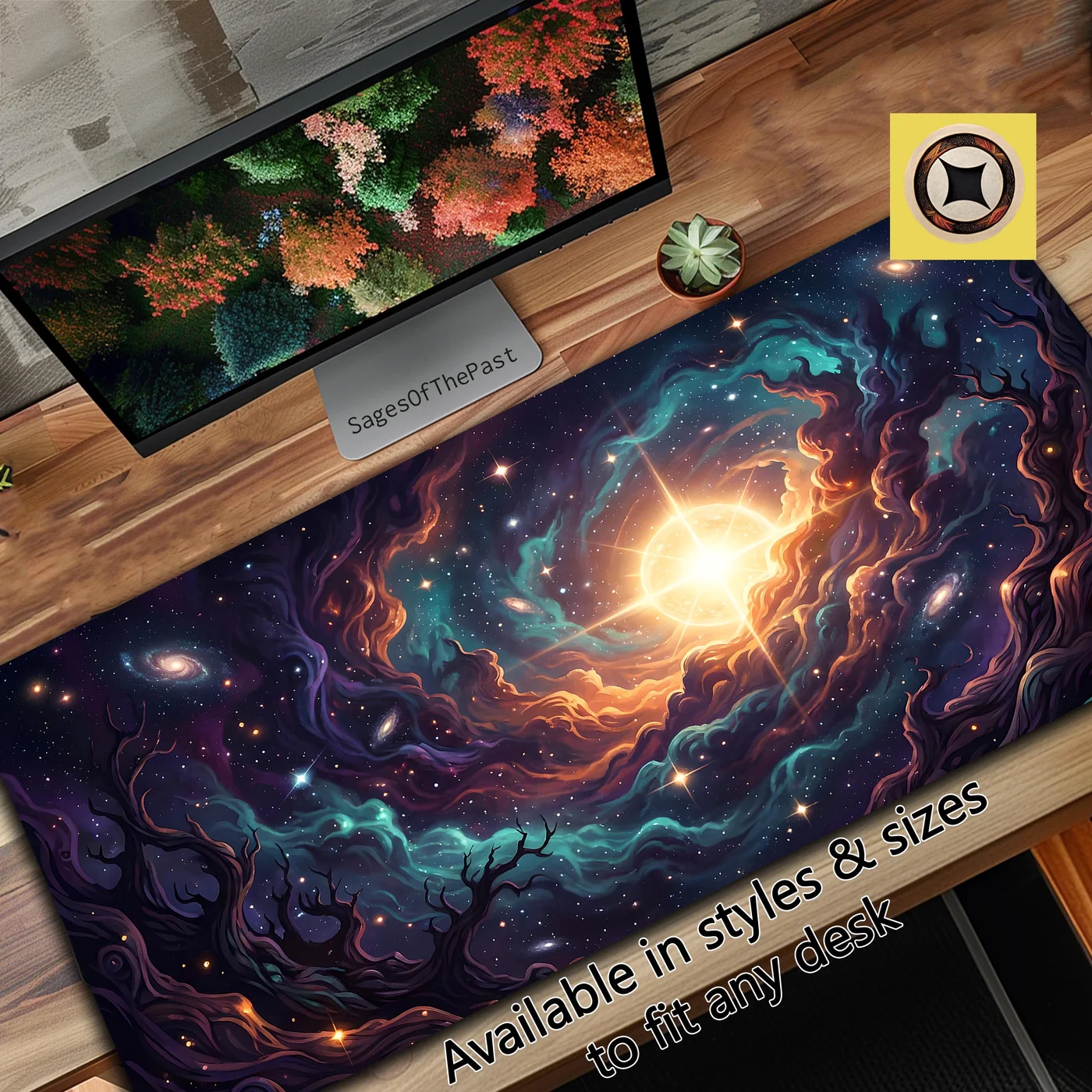
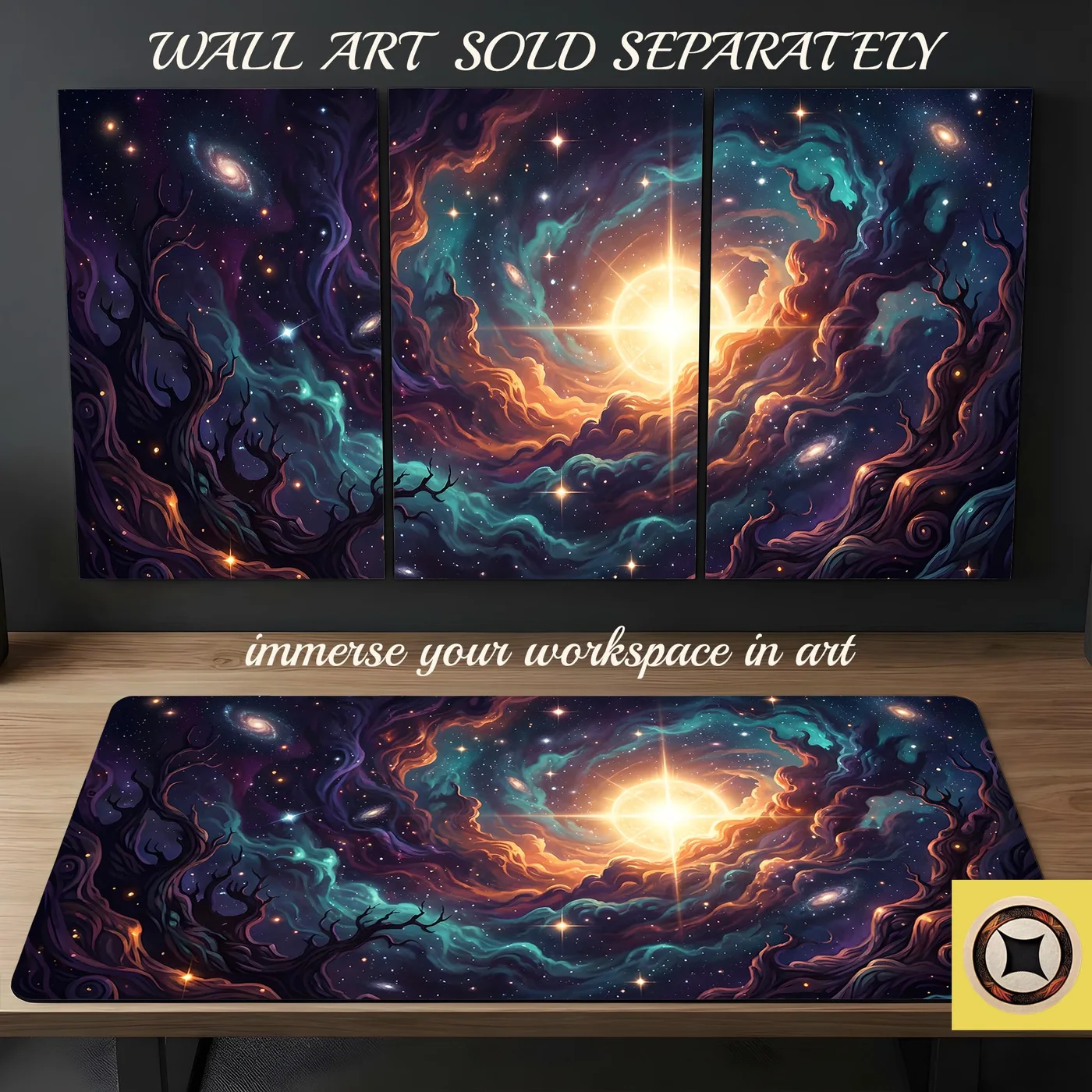
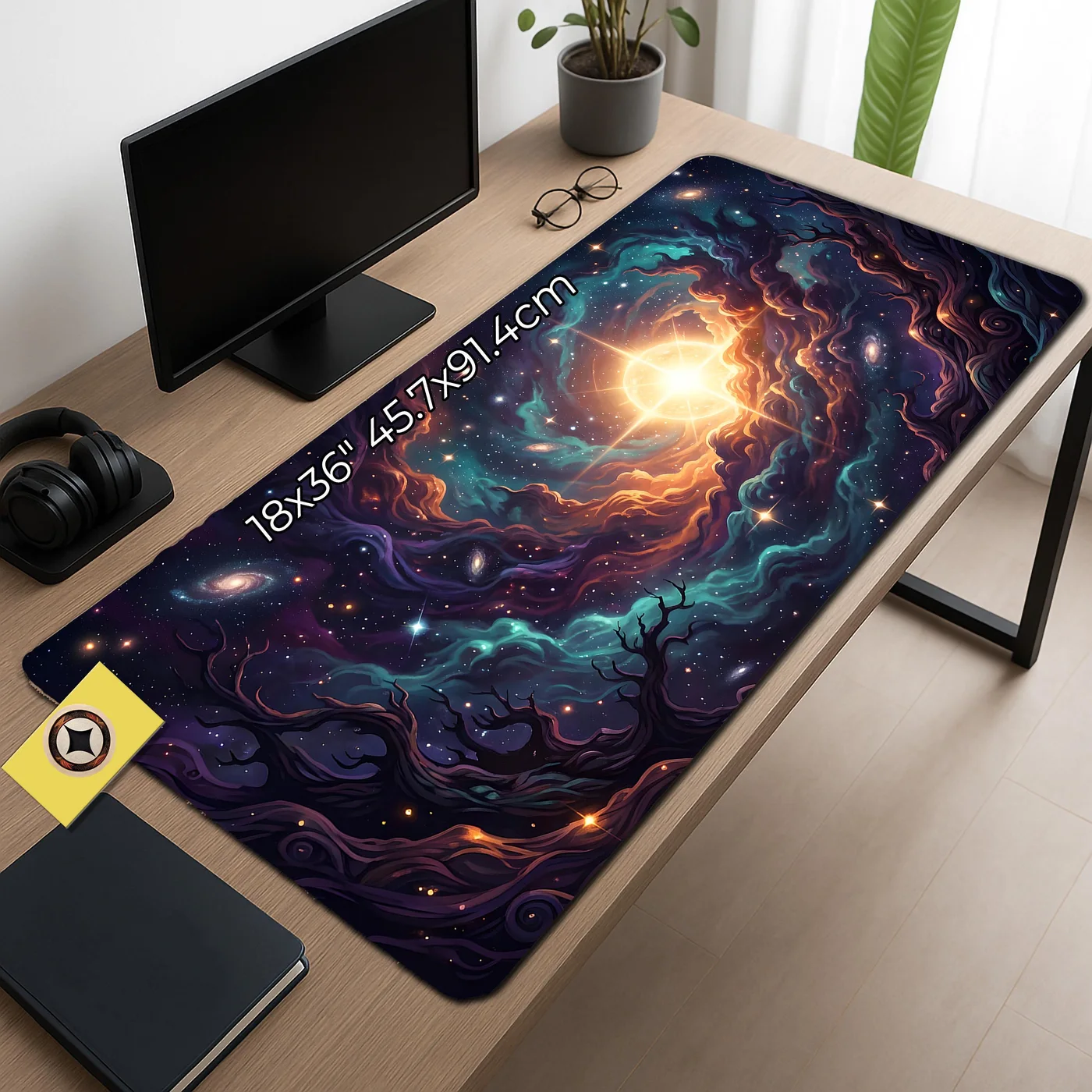
There are nights when the room is nothing but a square of darkness stitched around the pale window, and the only heartbeat belongs to the quiet machinery on your desk. On such a night you clear a space, roll out a simple cylinder of cloth and rubber, and suddenly the ordinary table is not a table at all—it is an airlock door swinging wide, an observatory dome splitting to reveal the long, slow wheel of forever. The mat unfurls and space spills over the wood, cool and velvet‑black, stars dusted like sugar across the dark.
At the center of this little universe is a sun that is not our sun, a bright, golden engine burning in perfect, impossible stillness. It throws spears of light in every direction, crosshairs of radiance reaching toward the edges of reality. Around it, nebulae curl in turquoise, violet, and ember‑orange, clouds behaving like ocean waves and campfire smoke at the same time. They twist and braid and lean inward, as though the whole cosmos has paused in the act of listening to some secret spoken in light alone.
The galaxies are shy but present. Here a spiral tilts like a thrown coin, edge catching starlight; there an elliptical smudge whispers of a billion suns pressed into a thumbprint on the dark. Tiny stars scatter themselves with no regard for grids or maps, free and stubborn. Between them wind strange, branchlike shadows—cosmic trees, if trees grew from gravity instead of soil. Their limbs stretch and curl, framing the blazing heart of the scene the way gnarled branches frame a harvest moon in some remembered childhood autumn.
You lay your hands at the bottom edge, fingers resting on painted roots of darkness, and you feel—if only in imagination—the slight hum of a ship under power, the rattle of dice echoing like meteor strikes, the shuffle of cards mimicking the slow rearrangement of constellations. Every movement of your mouse is a small course correction through the starfield; every keystroke is a message fired into the void, waiting for an answer. Here, a last‑second victory feels like a nova flaring to life; a quiet loss feels like a satellite slipping gently from orbit, resigned to the soft pull of gravity.
And if you are not gaming but working, writing, planning the messy architecture of your days, the mat is still busy at its quiet ministry. While you calculate and schedule, the golden star continues to burn without permission, reminding you that somewhere beyond these numbers and bullet points, there are storms of light older than history. Ideas seem to arrive from that bright center, streaking across your thoughts like comets, leaving tails of possibility behind. The task list is still the task list, but it floats now in a slightly larger sky.
When at last the night is finished—when the match is over, the chapter written, the deck put away—you reach out and touch the printed sun one more time. It is only ink on fabric, cool and matte under your fingertips, and yet some small heat seems to linger in your chest. You dim the monitor, push back your chair, and the room folds back into its earthly shapes: wall, window, lamp. Still, you carry with you the memory that for a while your elbows rested on the edge of an invented cosmos, and your hands moved among stars that answered to your slightest gesture. And you know that tomorrow, or the night after, or on some future evening when the world feels too heavy and too small, the galaxy will be waiting patiently on your desk, ready once more to light itself from within.
Continue through the story atlas